
研究テーマ
統合的認知の心理学
ーAORTASプロジェクトー

我々は、視覚系の情報処理過程によって、周囲環境もしくは外的世界についての豊富で詳細な情報を得ることができる。そ のような過程における、様々な特徴や多感覚を結び付ける統合的認知の役割を解明することが重要 である。旧来の脳科学や神経生理学で取組まれている要素還元的な脳機能の理解ではなく、人間の行動を理解するための認知心理学的なアプローチを中心とする 研究を目指す。そこで、いくつかの研究課題に分けて、統合的認知に 関する研究を進めている。具体的には、注意(Attention)、オブジェクト・情景認知(Object & scene perception)、身体と空間の表象(Representation of body and space)、感覚融合認知(Trans-modal perception)、美感(Aesthetics)、共感覚(Synesthesia)という研究テーマに取組んでおり、その頭文字をとってAORTASプロジェクトと名付けている。AORTASと いう命名には、各研究テーマの解明が”大動脈(aortas)”となって、”心”の科学的理解に至るという研究目標が込められている。
- Attention(注意):形状や色などの視覚特徴の統合的認知
- Object & scene perception(オブジェクト・情景認知):視覚要素やレイアウトの統合的認知
- Representation of body & space(身体と空間の表象):身体と行動空間の統合的認知
- Trans-modal perception(感覚融合認知):視聴覚や視触覚などの感覚同士の統合的認知
- Aesthetics(美感):視覚特徴と生活環境や文化などとの統合的認知
- Synesthesia(共感覚):視覚特徴間、感覚間の誤統合的認知
主な研究成果(最近の学術論文の解説はこちら、主な学 術論文の掲載学術誌別一覧はこちら、すべての研究成果一覧はこちら)
- 横澤一彦 編(2022). 認知科学講座4 心をとらえるフレームワークの展開、東京大学出版会

- 横澤一彦 (2021). 感じる認知科学、新曜社

- 浅野倫子、横澤一彦 (2020). 共感覚 統合の多様性、勁草書房
- 横澤一彦、積山薫、西村聡生 (2020). 身体と空間の表象 行動への統合、勁草書房
- 廣瀬通孝 監修 (2019). ト
コトンやさしいVRの本、日刊工業新聞
社 [分担執筆]
- 三浦佳世、川畑秀明、横澤一彦 (2018). 美感
感と知の統合、勁草書房
- 横澤一彦 (2017). つじつま
を合わせたがる脳、岩波書店

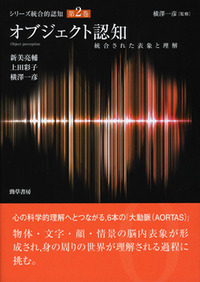
- 新美亮輔、上田彩子、横澤一彦 (2016). オブ
ジェクト認知 統合された表象と理解、勁草書房
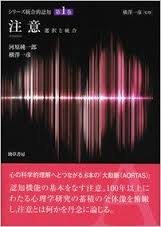
- 河原純一郎、横澤一彦 (2015). 注意
選択と統合、勁草書房
- 横澤一彦 (2010). 視覚科
学、勁草書房

- L. Okubo & K. Yokosawa (in press). Attentional allocation and the pan-field color illusion, Journal
of Vision.
- K. Uno & K. Yokosawa (2022). Cross-modal correspondence between auditory pitch and visual elevation modulates audiovisual temporal recalibration, Scientific Reports, https://doi.org/10.1038/s41598-022-25614-3.
- K. Uno & K. Yokosawa (2022). Pitch-elevation and pitch-size crossmodal correspondences do not affect temporal ventriloquism, Attention, Perception & Psychophysics.
- D. Mine & K. Yokosawa (2021). Adaptation to delayed visual feedback of the body movement extends multi-sensory peripersonal space, Attention, Perception & Psychophysics.
- D. Mine, S. Kimoto, & K. Yokosawa (2021). Obstacles affect perceptions of egocentric distances in virtual environments, Frontiers in Virtual Reality.
- D. Mine & K. Yokosawa (2021). Remote hand: Hand-centered peripersonal space transfers to a disconnected hand avatar, Attention, Perception & Psychophysics, 83, 3250-3258..
- N. B. Root, M. Asano, H. Melero, C.-Y. Kim, A. V. Sidoroff-Dorso, A. Vatakis, K. Yokosawa, V. S. Ramachandran, & R. Rouw (2021). Do the colors of your letters depend on your language? Language-dependent and universal influences on grapheme-color synesthesia in seven languages, Consciousness and Cognition.
- D. Mine & K. Yoksoawa (2021). Does response facilitation to visuo-tactile stimuli around remote-controlled hand avatar reflect peripersonal space or attentional bias? Experimental Brain Research.
- L. Okubo, K. Yokosawa, M. Sawayama, & T. Kawabe (2021). Discounting mechanism underlies extinction illusion, Consciousness and Cognition.
- K. Uno, M. Asano, & K. Yokosawa (2021). Consistency of synesthetic association varies with grapheme familiarity: A longitudinal study of grapheme-color synesthesia, Consciousness and Cognition.
- D. Mine & K. Yokosawa (2021). Disconnected hand avatar can be integrated into the peripersonal space, Experimental Brain Research, 239, 1, 237-244.
- K. Uno & K. Yokosawa (2020). Apparent physical brightness of graphemes is altered by their synaesthetic colour in grapheme-colour synaesthetes Scientific Reports, 10:20134. DOI:10.1038/s41598-020-77298-2
- D. Mine, N. Ogawa, T. Narumi, & K. Yokosawa (2020). The relationship between the body and the environment in the virtual world: The interpupillary distance affects the body size perception. PLOS ONE 15(4): e0232290.
- K. Uno, M. Asano, H. Kadowaki, & K. Yokosawa (2020). Grapheme-color associations can transfer to novel graphemes when synesthetic colors function as grapheme “discriminating markers", Psychonomic Bulletin & Review, 27, 4, 700-706.
- M. Asano, S. Takahashi, T. Tsushiro, & K. Yokosawa (2019).
Synaesthetic colour associations for Japanese Kanji characters: From
the perspective of grapheme learning, Philosophical Transaction of The Royal Society B, 374: 20180349.
- E. Kumakura, K. Schmid, K. Yokosawa, & A. Werner (2019).
Subjective evaluation of natural high-saturated images on a wide gamut
display, Color Research and Application, 44, 6, 886-893.
- E. Matsuda, Y. Okazaki, M. Asano, K. Yokosawa (2018). Developmental Changes in Number Personification by Elementary School Children, Frontiers in Psychology, 9:2214, DOI:10.3389/fpsyg.2018.02214
- Q. Li, R. Nakashima, & K. Yokosawa (2018). Task-irrelevant spatial dividers facilitate counting and numerosity estimation, Scientific Reports, 8:15620. DOI:10.1038/s41598-018-33877-y
- N. B. Root, R. Rouw, M. Asano, C.-Y. Kim, H. Melero, K. Yokosawa, & V. S. Ramachandran (2018). Why is the synesthete's "A" red? Using a five-language dataset to disentangle the effects of shape, sound, semantics, and ordinality on inducer-concurrent relationships in grapheme-color synesthesia, Cortex, 99, 375-389.
- R. Nakashima & K. Yokosawa (2018). To see dynamic change: Continuous focused attention facilitates change detection, but the effect persists briefly, Visual Cognition, 26, 1, 37-47.
- R. Niimi, H. Shimada, & K. Yokosawa (2017). Inhibition of Return Decays Rapidly When Familiar Objects Are Used. Japanese Psychological Research, 59, 2, 167-177.
- J. Nagai, K. Yokosawa, & M. Asano (2016). Biases and regularities of grapheme-colour associations in Japanese nonsynaesthetic population, Quarterly Journal of Experimental Psychology, 69, 1, 11-23.
- K. Nonose, R. Niimi, & K. Yokosawa (2016). On the
three-quarter view advantage of familiar object recognition, Psychological
Research, 80, 6, 1030-1048.
- R. Nakashima, Y. Komori, E. Maeda, T. Yoshikawa, & K. Yokosawa (2016). Temporal Characteristics of Radiologists' and Novices' Lesion Detection in Viewing Medical Images Presented Rapidly and Sequentially, Frontiers in Psychology, 7:1553, DOI: 10.3389/fpsyg.2016.01553
- C. Ishiguro, K. Yoksoawa, & T. Okada (2016). Eye movements during art appreciation by students taking a photo creation course, Frontiers in Psychology, 7:1074, DOI: 10.3389/fpsyg.2016.01074
- K. Yokosawa, K. B. Schloss, M. Asano, & S. E. Palmer (2016). Ecological Effects in Cross-Cultural Differences between US and Japanese Color Preferences, Cognitive Science, 40, 7, 1590–1616.
- G. Sastyin, R. Niimi, & K. Yokosawa (2015). Does object view influence the scene consistency effect?, Attention, Perception & Psychophysics, 77, 3, 856-866.
- S. Kanaya, W. Fujisaki, S. Nishida, S. Furukawa, &
K. Yokosawa
(2015). Effects
of frequency separation and diotic/dichotic
presentations on the alternation frequency limits in audition derived
from a temporal phase discrimination task, Perception,
44, 2, 198–214.
- R. Nakashima, C. Watanabe, E. Maeda, T. Yoshikawa, I. Matsuda, S. Miki, & K. Yokosawa (2015). The effect of expert knowledge on medical search: Medical experts have specialized abilities for detecting serious lesions, Psychological Research, 79, 5, 729-738.
- W. Yamashita, R. Niimi, S. Kanazawa, M. Yamaguchi K., & K. Yokosawa (2014). Three-quarter view preference for three-dimensional objects in 8-month-old infants, Journal of Vision, 14(4), 5, 1-10. doi:10.1167/14.4.5
- K. Tamaoka, M. Asano, Y. Miyaoka, & K. Yokosawa (2014). Pre- and post-head processing for single- and double-scrambled sentences of a head-final language by the eye tracking method, Journal of Psycholinguistic Research, 43, 2, 167-185..
- E. Maeda, T. Yoshikawa, R. Nakashima, K. Kobayashi, K. Yokosawa, N. Hayashi, Y. Masutani, N. Yoshioka, M. Akahane & K. Ohtomo (2013). Experimental system for measurement of radiologists' performance by visual search task, SpringerPlus, 2:607. DOI: 10.1186/10.1186/2193-1801-2-607
- M. Asano & K. Yokosawa (2013). Grapheme learning and grapheme-color synesthesia: Toward a comprehensive model of grapheme-color association, Frontiers in Human Neuroscience, 7:757. DOI: 10.3389/fnhum.2013.00757
- M. Asano & K. Yokosawa (2013). Determinants of synaesthetic colours for different types of graphemes: Towards a comprehensive model, Visual Cognition, 21, 6, 674-678.
- R, Nakashima, K. Kobayashi, E. Maeda, T. Yoshikawa, & K. Yokosawa (2013). Visual search of experts in medical image reading: The effect of training, target prevalence, and expert knowledge, Frontiers in Psychology, 4:166. DOI: 10.3389/fpsyg.2013.00166.
- R. Nakashima & K. Yokosawa (2013). Visual search in divided areas: Dividers initially interfere with and later facilitate visual search, Attention, Perception & Psychophysics, 75, 2, 299-307.
- S. Kanaya, Y. Matsushima, & K. Yokosawa (2012). Does Seeing Ice Really Feel Cold? Visual-Thermal Interaction under an Illusory Body-Ownership, PLoS ONE, 7(11): e47293. DOI:10.1371/journal.pone.0047293
- M. Asano & K. Yokosawa (2012). Synesthetic colors for Japanese late acquired graphemes, Consciousness and Cognition, 21, 2, 983-993.
- R. Nakashima & K. Yokosawa (2012). Sustained attention can create an (illusory) experience of seeing dynamic change, Visual Cognition, 20, 3, 265-283.
- A. Nishimura & K. Yokosawa (2012). Effects of Visual Cue and Response Assignment on Spatial Stimulus Coding in Stimulus-Response Compatibility. Quarterly Journal of Experimental Psychology, 65, 1, 55-72.
- M. Asano & K. Yokosawa (2011). Synesthetic colors are elicited by sound quality in Japanese synesthetes, Consciousness and Cognition, 20, 4, 1816-1823.
- A. Saneyoshi, R. Niimi, T. Suetsugu, T. Kaminaga, & K. Yokosawa (2011). Iconic memory and parietofrontal network: fMRI study using temporal integration, NeuroReport, 22, 11, 515-519.
- R. Niimi, A. Saneyoshi, R. Abe, T. Kaminaga, & K. Yokosawa (2011). Parietal and frontal object areas underlie perception of object orientation in depth, Neuroscience Letters, 496, 35-39.
- M. Asano & K. Yokosawa (2011). Rapid extraction of gist from visual text and its influence on word recognition, The Journal of General Psychology, 138, 2, 127-154.
- R. Nakashima & K. Yokosawa (2011). Does scene context always facilitate retrieval of visual object representations?, Psychonomic Bulletin & Review, 18, 2, 309-315.
- S. Kanaya & K. Yokosawa (2011). Perceptual congruency of audio-visual speech affects ventriloquism with bilateral visual stimuli, Psychonomic Bulletin & Review, 18, 1, 123-128.
- A. Nishimura & K. Yokosawa (2010). Visual and auditory accessory stimulus offset and the Simon effect. Attention, Perception & Psychophysics. 72 1965-1974.
- A. Nishimura & K. Yokosawa (2010). Response-specifying cue for action interferes with perception of feature-sharing stimuli. Quarterly Journal of Experimental Psychology, 63, 6, 1150-1167.
- A. Nishimura & K. Yokosawa (2010). Effector identity and orthogonal stimulus-response compatibility in blindness to response-compatible stimuli. Psychological Research, 74, 2, 172-181.
- A. Nishimura & K. Yokosawa (2009). Effects of laterality and pitch height of an auditory accessory stimulus on horizontal response selection: The Simon effect and the SMARC effect. Psychonomic Bulletin & Review, 16, 4, 666-670.
- R. Niimi & K. Yokosawa (2009). Viewpoint dependency in the recognition of non-elongated familiar objects: Testing the effects of symmetry, front-back axis, and familiarity. Perception, 38, 4, 533-551.
- R. Niimi & K. Yokosawa (2009). Three-quarter views are subjectively good because object orientation is uncertain. Psychonomic Bulletin & Review, 16, 2, 289-294.
- M. Asano, S. Kanaya, & K. Yokosawa (2008). Proofreaders show a generalized ability to allocate spatial attention to detect changes. Psychologia, 51, 2, 126-141.
- R. Niimi, K. Watanabe, & K. Yokosawa (2008). The dynamic-stimulus advantage of visual symmetry perception. Psychological Research, 72, 5, 567-579.
- A. Ariga & K. Yokosawa (2008). Contingent attentional capture occurs by activated target congruence. Perception & Psychophysics, 70, 4, 680-687.
- A. Ariga & K. Yokosawa (2008). Attentional awakening: Gradual modulation of temporal attention in rapid serial visual presentation. Psychological Research, 72, 2, 192-202.
- R. Niimi & K. Yokosawa (2008). Determining the orientation of depth-rotated familiar objects. Psychonomic Bulletin & Review, 15, 1, 208-214.
- A. Nishimura & K. Yokosawa (2007). Preparation for horizontal or vertical dimensions affects the right-left prevalence effect. Perception & Psychophysics, 69, 7, 1242-1252.
- A. Ariga, K. Yokosawa, & H. Ogawa (2007). Object-based attentional selection and awareness of objects. Visual Cognition, 15, 6, 685-709.
- Y. Hibi & K. Yokosawa (2007). On the Relation Between Object and Action: Response Consistency and Stimulus-Response Compatibility. Visual Cognition, 15, 3, 349-380.
- R. Niimi, K. Yokosawa, & K. Watanabe (2006). Attentional set for axis of symmetry in symmetry-defined visual search. Perception & Psychophysics, 68, 7, 1153-1162.
- M. Suganuma & K. Yokosawa (2006). Grouping and trajectory storage in multiple object tracking: Impairments due to common item motion. Perception, 35, 483-495. [demo]
- A. Nishimura & K. Yokosawa (2006). Orthogonal S-R compatibility effects emerge even when the stimulus position is irrelevant. Quarterly Journal of Experimental Psychology, 59, 6, 1021-1032.
- R. Niimi, K. Watanabe, & K. Yokosawa (2005). The role of visible persistence for perception of visual bilateral symmetry. Japanese Psychological Research, 47, 4, 262-270.
- K. Yokosawa, E. Wada, & H. Mitsumatsu (2005). Coding and transformation of cognitive maps in a
virtual environment. Electronics and Communications in Japan: Part 3,
88, 4 , 43 - 50.
- Y. Makino, K. Yokosawa, Y. Takeda & T. Kumada (2004). Visual
search and memory search engage extensive overlapping cerebral
cortices: An fMRI study. NeuroImage, 23, 525-533.
- T. Takeuchi, K. Yokosawa, & K.K. De Valois (2004). Texture
segregation by motion under low luminance levels. Vision Research, 44, 2, 157-166
- H. Mitsumatsu & K. Yokosawa (2003). Efficient
extrapolation of the view using the dynamic and predictive stimulus.
Perception,
32, 8, 969-983.
- J. Nagai & K. Yokosawa (2003). Negative
priming and stimulus familiarity: What causes opposite results? Memory
& Cognition, 31, 3, 369-379.
- K. Yokosawa & T. Kumada (2003). Voluntary
Aspects of Attentional Control Setting for Detecting A Feature-Defined
Target. Japanese Psychological Research, 45, 1, 1-14.
- K. Yokosawa & H. Mitsumatsu (2003). Does
disruption of a scene impair change detection? Journal
of Vision, 3, 1, 41-48.
- H. Mitsumatsu & K. Yokosawa (2002). How does the internal detail of the object contribute to recognition? Perception 31, 11, 1289-1298.